
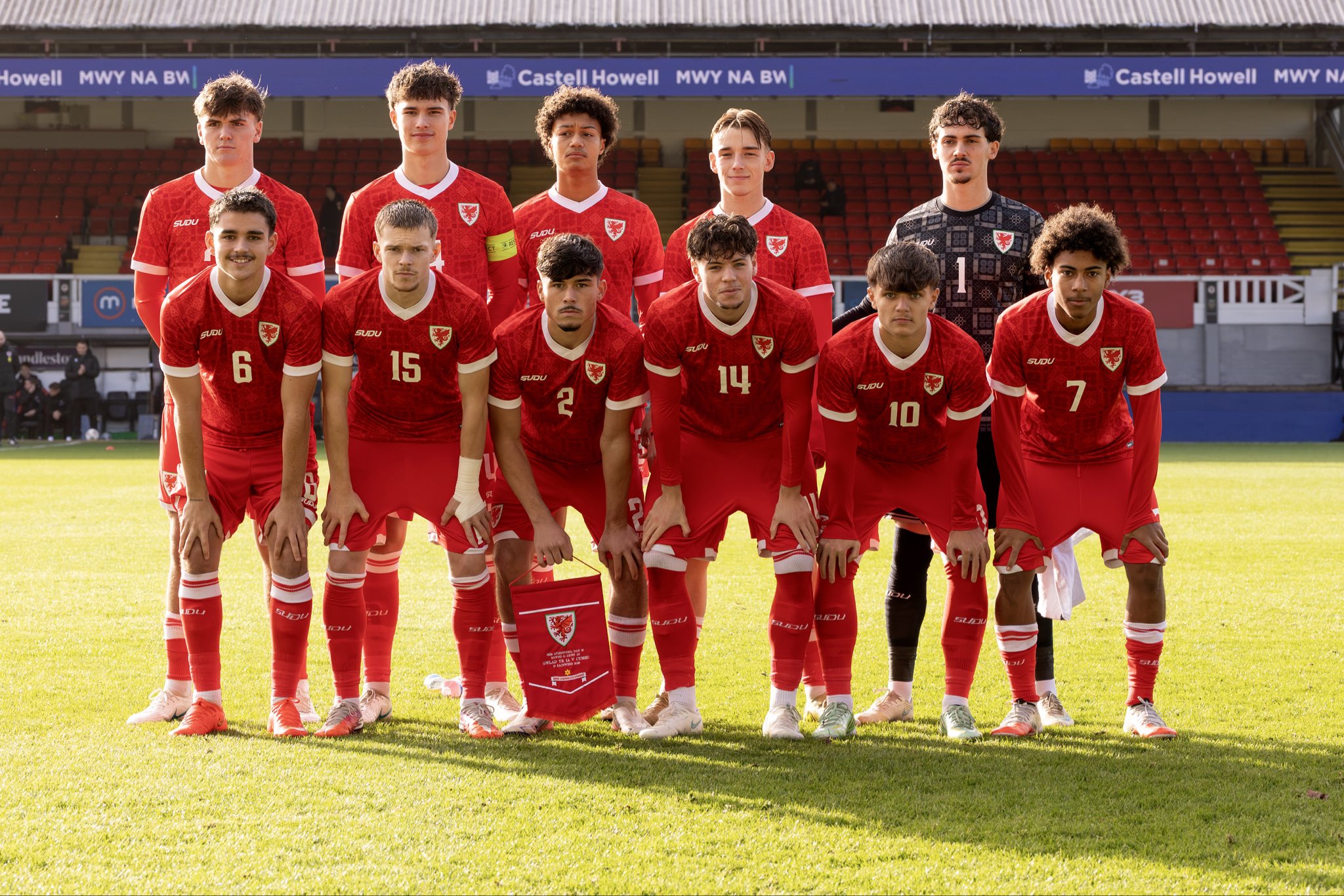
I’ve always been fascinated by how players end up representing their nation because it’s a very long road, involving lots of effort behind the scenes. I’ve also always had lots of questions, so during the international break, I spoke to James Holland at the FAW for what was a fascinating chat. It’s safe to say that the national side are in very safe hands.
What is your current job title at the Welsh FA and what is your remit in that position?
I’m the Head of Talent ID and Player Retention. Gus Williams, who was my predecessor, was the Senior Talent ID Manager and the day-to-day aspect is the same under both of these titles. The retention element included in my job title is a large part of the role is as well. Essentially, there are three areas; player identification, player monitoring and player retention. There will always be an element of one of those three things going on in terms of the work that I’m doing.
When I first spoke to you, it was a very busy international day, with several games at various age ranges. What would a typical international day consist of compared to a typical day outside the international window?
The international windows are the most qualitative time in terms of getting information on our players. I work with all of the individual coaches; Chief Football Officer Dave Adams, Richie Williams as head of player development, Craig Bellamy if he’s selecting the national team, plus all of the technical staff and coaches to pick the squads. When they’re actually in and playing, whether it be a training camp or fixtures, it’s an unbelievable time to assess and see up close those players.
We do lots of work in terms of live reports, video work and speaking to their clubs, but when they’re actually in with us, it’s completely different. To be in nine or 10 days at a time on a camp with us, you learn a lot about those young boys and young men. That time is hugely important for me and for the coaches.
If it’s on home soil, whether that’s in North or South Wales, it’s easy to be around the games, but like we had in this window, when there are multiple teams away at the same time, playing games at the same time, then it’s just making sure that we’re analysing and watching all those games back. If we can watch them live, great, but it’s a really busy time. Often during these international breaks, there’ll be upwards of 10 games that our youth teams and senior squad are involved in, so we’re analysing those during that window and then having debriefs and reviews thereafter.
Embed from Getty ImagesOnce the international break is finished, It’s quite varied. From August through to pretty much the third international break with September, October, November, that period of five months is really different to January through the summer months. There are shorter times between camps, so it’s a little bit more pressurised in terms of making sure that we’re doing enough work with the clubs and with the various coaches to understand the players that we’ve got in the system who are eligible for us.
A lot of this time is working with the coaches very closely, so I’ll coordinate all of the youth coaches and audit each of the squads, making sure that between myself, the head coaches and the relevant technical staff that we are getting to watch these players in the appropriate fixtures. Sometimes that’s live, sometimes it’s on video or highlights packages. There are conversations with their clubs and a quite a holistic approach.
When I came into the role, we had around 20 scouts. If you looked at a map of the UK, you would have had a set of initials next to most regions, which is typically how it works at an academy or a first team level. It’s a little bit more data led now, but in the past there would be a reasonably high volume of part-time or voluntary scouts and that is definitely how I would run a club. After a few months in the role, my feeling was that we’re very fortunate to have full-time head coaches in most positions across the boys and the girls sides, some of whom have dual roles in the association. We have five or six head coaches, plus Richie, myself, Dave, Craig and his assistants. Suddenly you have 10 or 12 technical staff who are the decision makers around each squad and are the key people who the players want to be hearing from, the clubs want to be hearing from and the ones who are closest to all the action.
If you’re looking at a Category 1 or Category 2 academy programme or a Championship first team programme, they’re all playing 50 games a season and they’re all training probably 250 days of the year. Some of our year groups and the first team may be in for 50 to 60 days a year across all the international breaks and generally we’re playing 10 games a season, of which maybe a handful of players may be injured and might only play in six or eight of those. At Under 15 and 16 level, we’re finding so many new players that those squads would typically turn over by about 40-50%, so what I was finding was although we had some good scouts at various places who were really happy to help us and would cover games, what we probably started doing is using them more from a kind of informal knowledge sharing.
Embed from Getty ImagesOur heads of academy recruitment, after using them from more of an eligibility searching perspective already had access to the clubs, but when it comes to actually monitoring, watching those players and doing the club visits, I just felt that we needed quality over quantity. The clubs and the players want to hear from our coaches. You build trust and make sure that we’ve got exactly the right focus and motivations around players coming in. If we’re selecting a 20 or 25 person squad quite regularly, you’ll probably know the best 13 or 14 players, but it’s making sure that we’re content and comfortable picking the remainder. There may be 30-40 players that we’re considering for a squad of 20 and it’s making sure that our coaches or myself have spoken to the club and done our homework to make sure that we’re in that position.
During the international break prior to this one, we had Leon Scarlett, who came into our programme relatively late. He didn’t do the regional programme or play for the Under-15s. We found him a couple of years back and he came in with the Under-17s to begin with and this season he’s been in and around the QPR first team. He’s had some really good exposure and we had conversations internally around him being in a great place. The momentum was there with him. He was already going to be playing up a year with the under-19s, which he just did in this break, but in the previous one, we felt that accelerating him through to the Under-21s was the right thing to do. By having a lean, well-versed, cohesive unit, we can make those decisions pretty quickly. It’s a similar story with someone like Jayden Lienou, coming up into the national team over the last half a dozen or so windows. Just making sure that we can react quickly if someone is succeeding at their club and making sure that we can also reward them with us as well.
In 2012, the FAW set out a 10-year plan for talent identification. What did the task look like before and since that plan was implemented?
Before I came in and even for the first six months of my tenure, this was a one-person department, across the men’s, women’s, boys and girls. It was tough. To be able to have some support on the women’s and girls side now is great and we doubled the size of the department to get the necessary support in that space. Like everything on the women’s and girls side, the speed of change in that area is remarkable. We’re in conversations constantly about whether we can increase further and what support we need. Adrian Harvey, who is the Under-17s head coach at the moment, is a big supporter of our regional programme and helps me do a lot of the early identification. Its myself, Ryan Sullivan on the women and girls side, then Adrian supporting regional point of entry, working with me to help identify players.
We’ve kind of gone away from formal scouts, but we have to be networked, so if you start with the players that we’ve got in the system, we have to nail relationships with the clubs. If you frustrate them or you treat one of their players poorly, they’re going to be fairly demotivated in helping you unearth the next one. Some of these kids are 12 and 13 coming into our regional programme, even 11 at the very start of this pathway. We are reliant on those clubs doing eligibility checks for us. If we’re looking after their players and we’re doing those things correctly, then they’re far more likely to go out to parents to find future Welsh eligible players to come into the next regional programme. It ends up being a smooth cycle where you have chains of communication, with willingness to adhere and look after them.
Embed from Getty ImagesThese players belong to their clubs, but a huge part of their youth pathway is with us. Some of them will get between 30 and 50 youth caps and be away for 50 to 60 days a year with us. We play our part. The FAW’s coach education programme is globally known and we want as many Welsh coaches in there as possible. We also want to increase relationships with the Category 1 and 2 clubs that our players are coming from, to continually promote what we’re about.
In terms of the criteria that qualifies somebody to represent a particular country, is that the same as it’s always been? What are the criteria?
The three main criteria are the place of birth for a player, parent or grandparent, so if yourself, your parents or any of your grandparents were born in a particular territory or country, you are eligible to represent that nation. The fourth criteria is based around residency, which at the moment is five years in a particular country. If that country were to give you citizenship following that residency period, then you can also represent that country.
For us, there is also the home nations agreement, which has been tweaked over the years and this fourth criteria can be altered, removed or edited by any member associations who share a common nationality. It can be amended if there is a cohesive decision between the member associations who share a common nationality and British citizenship is held by a number of member associations including England, Scotland, Wales and Northern Ireland. I’ve spoken at length to FIFA about this and there was the hypothetical Matt Grimes scenario, who had done five years living in Wales. If we were any other country on Earth other than a home nation, he would have been eligible to play for them.
For us, someone educated for five years or more under the age of 18 can then go on to represent that particular territory. We’ve got several in our youth pathway who were not born in Wales, don’t have any blood links to Wales, but did or are doing at least five years of education before the age of 18.
Wales famously capped Harry Wilson when he was 16 to secure his services and it was pretty much three years before he was next selected for a squad. Does a competitive senior appearance still tie you down to a particular nation, or has that since changed?
At the moment, if you are under the age of 21, you can play three games for a country, then after a cooling off period you could still join another nation. Those games can be anything other than the group stage of a tournament, so qualifiers and friendlies only. Over the age of 21, a competitive game ties you to that country.
Embed from Getty ImagesIn terms of the talent identification, there’s a very clear path for youngsters coming through regional centres and then feeding through into the Under-15s. What a lot of people are interested by is the idea of players that might be out there knocking around in the Premier League that haven’t represented a particular nation and the idea of whether with a bit of rooting around, some Welsh heritage might be established. Is that something that the Welsh FA typically pursue to investigate eligibility?
Massively. You rely on networks, clubs and agents, but quite literally, I have gone through, for example, all goalkeepers. We’re all aware of the shortage that we have behind Karl Darlow and Wardy and the necessity to find some more goalkeepers, even though we’ve got some good ones in the pathway. Every single goalkeeper who is in a squad playing or not in the Premier League, Championship, League One or League Two, we have been through them individually to contact the club or their agents and ruled them all out individually. That is also not far off the case with anyone that would be of a relevant level in outfield as well.
We literally have giant databases of players who are of a relevant level and could improve the first team. The links have always been there with players like Keane Lewis-Potter, Callum Doyle, Joe Williams at Bristol City and Ryan Giles at Hull. I can categorically say that the effort level that we put into that is huge because we may find that one player who could make all the difference.
So presumably, there are people that you’ve contacted who are eligible and that you would be interested in that might turn you down or in the instance of say Karl Darlow, may be initially reluctant. Are there players that you’re monitoring in the hope that maybe further down the line, they might have a change of heart and become available?
Absolutely. If we do find a player, we don’t typically lose them. They stay with us because of the nature of the pathway and the fact that they build that sense of belonging and culture early with us. Ashley Phillips, who was with us at Under-15 level, is the only current player that we have lost to another nation that we wanted to keep. Mikey Moore is a high profile one that’s been spoken of publicly in the media and someone like Rodri Smith, who’s at Young Boys on loan at the moment. We’ve known about him for three plus years and I’ve been speaking to the family there. Aiden Stokes, the New York Red Bulls goalkeeper on loan at Brentford, who played four or five times for us, across the Under-15s and 16s is with the US national set-up and doing very well. We are incredibly active in that space.
The challenge is a significant one if we are second to a particular player and there is also the double whammy of the fact that a lot of players are also starring for the age group of their current nations. We know that the players already mentioned would improve our age groups or senior squad in, if not now, then the near future, so it shows the necessity to continue doing this as aggressively as we can, in the right manner, at an early age to continue bringing them in because if they come in, we don’t tend to lose them.
Embed from Getty ImagesWe need to build that feeling of being Welsh because lots of them aren’t born in Wales or have parents who aren’t born in Wales. I think Wales as a country does that incredibly well naturally and we’ve got very good cultural architects, whether that be certain coaches or education welfare officers, but the earlier we can find them, the better chance we have of retaining them and them continuing their pathway with us. We’re in constant conversations with every player that is eligible. It’s a constant part of what we do and I personally think as an association, we’re very good at it. Craig’s great, as is Rhian Wilkinson on the women’s side, both constantly offering themselves in terms of any support they can give, whether it be general conversations without putting any pressure on kids who might be dual national. Speaking to parents, explaining pathways. We’re very fortunate that we’ve got a very lean and selfless setup, where anyone who can help in any of those scenarios appropriately does so.
If there is a case of a young player that may qualify for multiple nations, how does that process work? Do the associations that have eligibility individually put their case forward to the parents, agents and the player?
In theory, a player under the age of 16 can bounce from nation to nation and end up with a handful of caps for however many they’re eligible for, with no consequences. Once you play at Under-17 level in a qualifier or tournament, you are essentially tying yourself to that nation. You can still jump to another nation, but you can only do so once.
The purpose of us having the regional programme is that we essentially put a marker down and create a sense of belonging. They come in for two days every school holiday and it’s a full two-year programme, between 24 and 28 days of contact over those two years. They would then play in the Cymru Cup and then we select our Under-15 squads. England have their first talent ID camps at Under-15, but by us already having our regional program running for two years, any high potential players, as has been done in recent years, might exit the regional program a year early and play for our Under-15s.
We’ve had lots of feedback from parents saying that the kids absolutely love being part of the regional programme and if someone of real high potential has already perhaps played a year up for us or been part of the regional programme for two years, then they’re more likely to stay with us than if they haven’t been. Over 60% of the men’s national team were identified and came through the regional programme, so by having that early identification and very strong relationships with the clubs, they’re more willing to help us identify these players. This year we’ve got more Category 1 academy players in our regional programme than we’ve ever had before and higher eligible numbers than we’ve ever had before.
Embed from Getty ImagesWe’re doing as much as we can in this space to be able to be in a place where we have the strongest age groups, but there is also senior opportunities for those players at 16, 17 or 18 years of age. They will get that opportunity if they’re good enough, so I think if you combine all those things together and you have a pretty clear kind of identity and concept.
There seems to be a sense security now within the FAW that may not have existed when they capped Harry Wilson so early. Regarding somebody like Gabrielle Bianchieri, who was born in Wales, has a Canadian mother and has recently trained with them, there seems to be more of an ease and confidence that Wales offer a strong alternative than they maybe previously did.
There’s been a fair amount of noise around Gabe and I think we’ve managed him well. He has done well getting his opportunity with Canada, training with them and has also done well with us. He’s a very clear example of our concept, giving him the opportunity to train with the senior squad from time to time and he will be a key part of the Under-21s in the next campaign as well. His options are open between Italy, Canada, and us. We’ve offered him a clear pathway through the youth age groups and as of now, he is really comfortable and sees his future with us.
To finish up, what does the future of talent identification look like within the Welsh FA?
To continue improving. We’re very fortunate to have the Premier League as a vehicle, the Championship, plus Category 1 and Category 2 academies, with Cardiff, Swansea, Wrexham and Newport all part of the English system. It’s never letting up on your relationships with those clubs, while getting more and more people through the FAW coach education programme. At Under-15 level, normally 10% of our first few squads are made-up of domestic-based players, so there is also talent in the Welsh domestic game at that age, so we have to make sure that they also have the opportunity to train to a high level regularly and hopefully at a professional club eventually. It’s a damning statistic that nobody has ever played for the men’s national team in recent times who was not at a pro academy by the age of 12. We’ve got one or two who might be in with a shot of bucking that trend at the moment in the pathway though.
We’ll also continue to do as much as we can proactively, in terms of contacting agents, speaking to the players that are not playing for any nation, whether in the US, Australia or wherever they may be. Clubs are increasingly using more and more sophisticated data, AI and modelling. Sports Interactive, literally the biggest football database in the world who create the Football Manager computer game series have an incredible team of researchers and they work very closely with a number of professional clubs as leading partners and providers for data. They also scrape and collect information on eligibility through various channels. We’ve explored pretty much every company you can think of, but the efforts and resources of these companies and the work that we’ve had has not really unveiled anything that we were not already aware of. The reality is networking and conversations is still the main way.
We’ve had numerous players from Australia coming over into the boys and girls pathways. Aiden Stokes from the US, Noa Williams, who’s over in Sarpsborg, Rhodri Smith from Switzerland. There’s plenty of these players, so we still do as much as we can in that space and we would love some extra support if we felt there was something out there. As an association, we have also been supporting a lot of our dual nationals on the passport and the citizenship side. We’ve committed considerable resources on legal firms to support the families of some of our players to gain British citizenship in advance of them turning 17 so that they can play for us.
It’s been a very interesting four years and we try to leave absolutely no stone unturned.